From the Couch to the Field and Back Again: The Real Health Cost of North Fulton's Weekend Warrior Habit

From the Couch to the Field and Back Again: The Real Health Cost of North Fulton's Weekend Warrior Habit
Picture a typical Thursday evening in Alpharetta or Roswell. A North Fulton professional wraps up a long day at a desk, logs off a video call, and mentally plans the weekend ahead: a 5K on Saturday morning, a recreational soccer match in the afternoon, and a full day of landscaping on Sunday. By Monday, the same person is back at the desk — stiff, sore, and silently vowing to "take it easier next time."
This pattern is so common it has earned a clinical nickname: weekend warrior syndrome. And while the impulse to pack physical activity into 48 hours is understandable given the demands of modern suburban life, the health consequences can be far more serious than a little muscle soreness. At North Fulton Hospital, our orthopedic and sports medicine specialists see the results of this cycle regularly — and they want residents to understand what's really happening inside the body when activity is compressed rather than distributed.
What Makes the Weekend Warrior Pattern So Risky
The human musculoskeletal system is remarkably adaptable, but only when it is challenged gradually and consistently. When the body spends five days in a largely stationary state — seated at a workstation, commuting, or resting — muscles, tendons, and connective tissues begin to tighten and lose their functional readiness. Circulation to these tissues slows, and the neuromuscular coordination that helps the body move efficiently starts to dull.
Then comes the weekend. Suddenly, those same tissues are asked to perform at high intensity: sprinting after a soccer ball, lifting heavy mulch bags, or sustaining a long trail run. The mismatch between the body's conditioned state and the demands being placed on it is where injury originates.
Acute injuries — sprains, strains, and muscle tears — are the most immediate concern. But the risks extend beyond a single weekend. Repeated cycles of inactivity followed by intense exertion create cumulative stress on joints, tendons, and cartilage. Over time, this pattern contributes to overuse injuries that develop slowly and are often dismissed until they become debilitating. Conditions like patellar tendinitis, rotator cuff irritation, plantar fasciitis, and stress fractures frequently trace back not to a single traumatic event, but to months or years of this inconsistent loading pattern.
Cardiovascular risk is another dimension that deserves attention. Research has shown that sudden, vigorous exertion in individuals who are otherwise sedentary can temporarily elevate the risk of cardiac events, particularly in those with undiagnosed heart conditions. This is not a reason to avoid activity — far from it — but it is a compelling argument for building up to intensity gradually rather than surging into it cold.
Why North Fulton's Lifestyle Makes This Especially Common
North Fulton County's demographics create a near-perfect environment for weekend warrior behavior to take hold. The region is home to a high concentration of professionals in demanding, desk-based careers. Commute times, long work hours, and family obligations leave little room for midweek exercise during a typical Monday through Friday schedule.
At the same time, North Fulton offers an abundance of recreational opportunities: well-maintained greenway trails, community athletic leagues, golf courses, and expansive residential lots that require regular upkeep. The appetite for outdoor activity is high. The time available for it during the week is low. The result is a predictable compression of physical effort into the weekend — and a predictable pattern of injury.
Recognizing Overuse Injuries Before They Become Serious
One of the most important things a weekend warrior can do is learn to distinguish normal post-exercise soreness from the early signals of an overuse injury. Delayed onset muscle soreness — the familiar aching that peaks 24 to 48 hours after activity — is a normal physiological response and typically resolves on its own within a few days.
Overuse injuries present differently. Watch for the following warning signs:
- Pain that persists beyond 72 hours after an activity session
- Localized tenderness over a specific joint, tendon, or bone rather than general muscle fatigue
- Swelling or warmth around a joint that does not resolve with rest and ice
- Pain that worsens during activity rather than improving as the body warms up
- A pattern of recurring discomfort in the same area across multiple weekends
These symptoms deserve prompt attention. Continuing to push through an overuse injury rarely accelerates recovery — it typically prolongs it and increases the likelihood of a more serious structural problem developing.
Strategies for Breaking the Cycle Without Giving Up Activity
The goal is not to discourage North Fulton residents from being active. Physical activity is one of the most powerful contributors to long-term health and disease prevention. The goal is to redistribute that activity in a way the body can safely support.
Build movement into weekday routines. Even modest additions make a meaningful physiological difference. A 20-minute walk at lunch, a brief bodyweight routine before dinner, or a short bike ride after work begins to maintain the muscle readiness and cardiovascular conditioning that makes weekend activity far safer. Consistency matters more than duration.
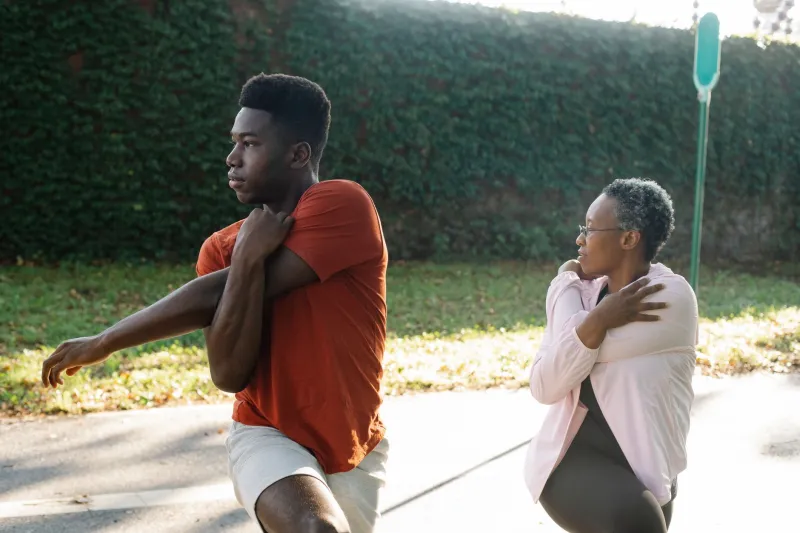
Warm up with intention. Before any vigorous weekend activity, spend at least 10 minutes on dynamic movement — leg swings, arm circles, light jogging, and mobility exercises specific to the sport or task ahead. Static stretching of cold muscles is less effective and potentially counterproductive; dynamic movement activates the neuromuscular system and prepares joints for load.
Progress gradually. If you are returning to a sport or activity after a period of reduced movement, resist the urge to perform at your previous peak level immediately. A general guideline from sports medicine practitioners is to increase training load by no more than 10 percent per week. This applies to distance, duration, and intensity.
Prioritize recovery as seriously as the activity itself. Sleep, hydration, and nutrition are not optional components of an active lifestyle — they are integral to it. Adults who consistently under-sleep or under-fuel their bodies are significantly more susceptible to injury, regardless of how carefully they train.
Cross-train across the weekend. Rather than concentrating all effort into one prolonged high-intensity session, consider distributing activity across Saturday and Sunday and varying the type of movement. Alternating between cardiovascular activity, strength work, and flexibility training reduces the repetitive stress on any single tissue group.
When to Seek Evaluation from a Specialist
Many weekend warriors delay seeking care because they assume their pain is a normal consequence of activity — something to be endured rather than treated. This assumption is costly. Early evaluation by an orthopedic or sports medicine specialist can identify a developing injury before it becomes a structural problem, often allowing treatment with conservative interventions like physical therapy, activity modification, or targeted strengthening rather than more invasive measures.
At North Fulton Hospital, our sports medicine team works with patients across the full spectrum of activity levels — from competitive athletes to recreational enthusiasts who simply want to enjoy their weekends without consequence. If you are experiencing recurring pain, a joint that doesn't feel right, or movement limitations that are affecting your daily life, a timely evaluation is the appropriate next step.
Do not wait until the injury forces the decision. Seeking care early is an act of self-advocacy — and one of the most effective things you can do to protect your ability to stay active for years to come.
A Sustainable Path Forward
North Fulton's residents have every reason to value physical activity, and every opportunity to pursue it. The weekend warrior pattern, however, is a compromise that the body eventually refuses to accept. By distributing movement more evenly across the week, approaching intensity with appropriate progression, and listening to the body's early warning signals, it is entirely possible to be both active and well.
North Fulton Hospital is here to support that goal — whether through preventive guidance, injury evaluation, or rehabilitation services designed to get you back to doing what you enjoy, safely and sustainably.