Fever and Your Child: A North Fulton Parent's Practical Guide to Knowing When to Go to the ER
Fever and Your Child: A North Fulton Parent's Practical Guide to Knowing When to Go to the ER
Few things rattle a parent quite like watching a child burn with fever in the middle of the night. The thermometer reads 103°F, your child is flushed and restless, and suddenly every worst-case scenario floods your mind. Should you rush to the emergency room? Wait until morning and call the pediatrician? Give children's acetaminophen and monitor things at home?
The honest answer is: it depends. And the factors it depends on are specific, learnable, and worth knowing before you find yourself in that moment of uncertainty. The clinical team at North Fulton Hospital has put together this guide to help Fulton County parents understand the difference between a fever that can be managed at home and one that requires immediate medical attention.
What a Fever Actually Is — and Why It Matters
A fever is not an illness in itself. It is the body's immune response to infection — a deliberate increase in core temperature designed to make the body a less hospitable environment for viruses and bacteria. In that sense, a fever is evidence that your child's immune system is working.
Most pediatric fevers are caused by common viral illnesses — colds, flu, roseola, and similar infections that resolve on their own within a few days. However, certain fevers signal something more serious, and the key variables are your child's age, how high the temperature climbs, how long it has persisted, and what other symptoms accompany it.
How to Take Your Child's Temperature Correctly
Before you can act on a number, you need to trust that the number is accurate. The method you use matters.
For infants under 3 months, a rectal temperature is the most reliable measurement. Use a digital thermometer specifically labeled for rectal use, apply a small amount of petroleum jelly to the tip, insert it no more than one inch into the rectum, and hold it gently in place until it beeps.
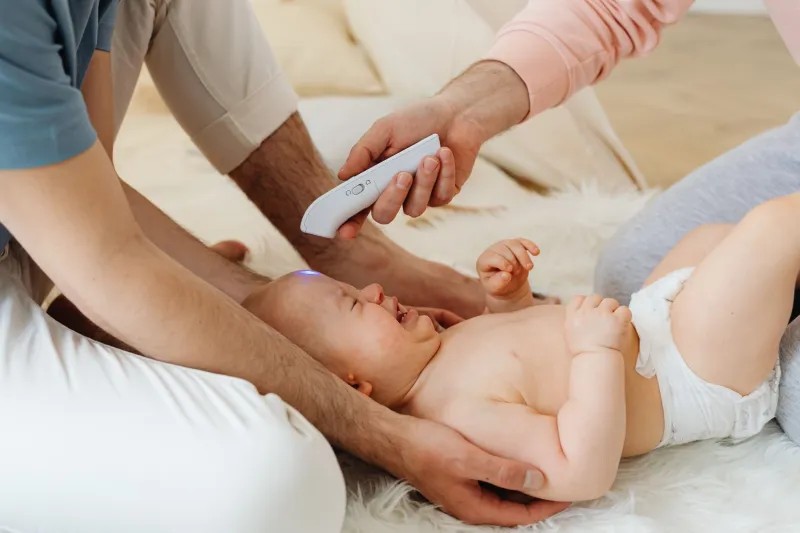
For children between 3 months and 3 years, rectal measurement remains the gold standard, though temporal artery (forehead) thermometers that are properly calibrated are also acceptable.
For children 4 years and older, oral or temporal artery readings are generally reliable. Ear thermometers can be used but are more prone to inaccurate readings if not positioned correctly.
Avoid axillary (underarm) temperatures as a sole diagnostic measure — they tend to run about one degree lower than core temperature and can lead you to underestimate the severity of a fever.
A fever is formally defined as a rectal temperature of 100.4°F (38°C) or higher.
Age-Based Thresholds: When the Rules Change
Age is the single most important factor in evaluating a pediatric fever. Young infants have immature immune systems and limited physiological reserves, which means a fever that would be entirely manageable in a school-age child can represent a genuine emergency in a newborn.
Under 3 months old: Any fever of 100.4°F or higher is a medical emergency. Do not wait. Do not give fever-reducing medication and re-evaluate. Go to the emergency room immediately. Neonatal and early infant fevers can be caused by serious bacterial infections — including meningitis and sepsis — that deteriorate rapidly without treatment.
3 to 6 months old: A temperature at or above 102°F warrants a same-day call to your pediatrician at minimum, and a trip to the ER if your child appears ill, is difficult to rouse, or is not feeding normally.
6 months to 2 years: Fevers up to 102°F in an otherwise alert, interactive child who is drinking fluids can often be monitored at home with appropriate comfort measures. Temperatures above 104°F, or any fever that persists beyond 48 hours without improvement, should be evaluated by a physician.
Children 2 years and older: Most fevers in this age group — even high ones — are not emergencies on their own. Context and accompanying symptoms become the primary guide.
Beyond the Number: Symptoms That Demand Immediate Attention
The temperature reading is one data point. What your child looks and acts like is often more telling. Seek emergency care immediately — regardless of the fever's height — if your child displays any of the following:
- Stiff neck or sensitivity to light, which can indicate meningitis
- A rash that does not fade when pressed (the "glass test"), particularly a purplish or reddish spotted rash, which may signal a serious bloodstream infection
- Difficulty breathing, labored breathing, or nostrils flaring with each breath
- Persistent, inconsolable crying or a high-pitched, unusual cry in infants
- Extreme lethargy — a child who is difficult to wake, unresponsive, or limp
- Seizure activity, even if brief
- Signs of dehydration: no tears when crying, no wet diapers for 8 or more hours, dry mouth, sunken eyes
- Fever that has lasted more than 5 days at any age
- A fever that returns after being fever-free for 24 hours, which may suggest a secondary infection
ER vs. Pediatrician: Making the Call
If your child is alert, making eye contact, accepting fluids, and responding to fever-reducing medication with some improvement in comfort and behavior, a call to your pediatrician during office hours is usually the appropriate first step. Most pediatric practices have after-hours lines for exactly these situations.
Head to the emergency room — without delay — if your child meets any of the age-based thresholds above, displays any of the warning symptoms listed, or if your instinct as a parent tells you something is genuinely wrong. Parental intuition is not an unreliable indicator. Emergency medicine physicians take it seriously, and so should you.
North Fulton Hospital's Emergency Department is equipped to evaluate and treat pediatric patients around the clock. Our team understands that a frightened parent and a sick child need both speed and compassion, and we are prepared to deliver both.
Managing Fever at Home When It Is Appropriate
When a fever does not meet emergency thresholds, there are safe and effective ways to keep your child comfortable while their immune system does its work.
Age- and weight-appropriate doses of acetaminophen (Tylenol) or ibuprofen (for children over 6 months) can reduce fever and ease discomfort. Never give aspirin to a child or teenager — it is associated with a rare but serious condition called Reye's syndrome.
Encourage fluids consistently. Fever accelerates fluid loss, and dehydration compounds the risk. Dress your child lightly and keep the room comfortably cool. Lukewarm baths can provide relief, though ice baths or cold water should be avoided.
And above all — keep watching. A child's condition can change quickly. Re-evaluate every few hours, and do not hesitate to escalate your response if things shift.
You Are Not Overreacting
One of the most common things parents say when they arrive at our emergency department is that they were afraid they were overreacting. In the vast majority of cases, they were not. When it comes to a sick child, erring on the side of caution is not a failure of composure — it is good parenting. North Fulton Hospital is here to support Fulton County families at every stage of a child's health journey, from reassurance to critical care.